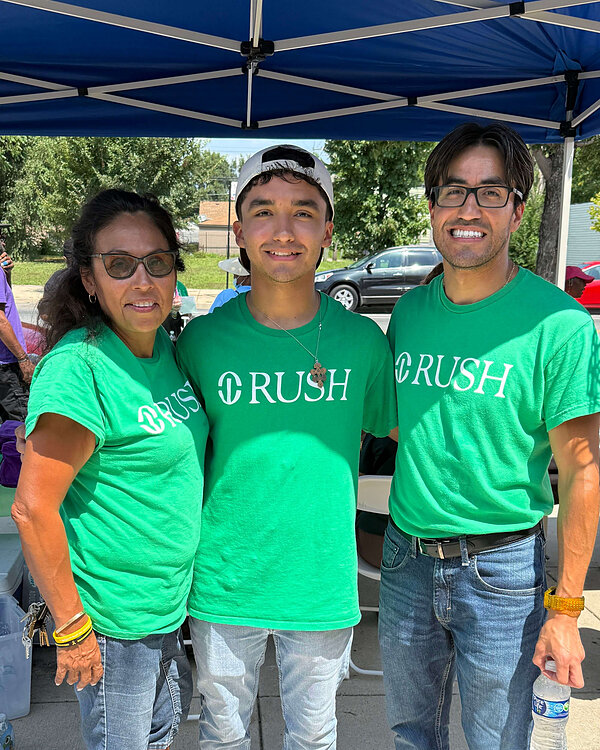
An unlikely pairing: music and medicine. Initially the two may lack commonality, but for rising sophomore Abraham Claudio there are many shared qualities.
Abraham Claudio, a sophomore biological sciences and psychology student from Chicago, spent his summer interning at Rush University Alzheimer’s Disease Center, and when not studying or attending classes, spends his semesters singing in Notre Dame’s mariachi band, MariachiND. The student-led organization uses mariachi music to celebrate and promote cultural heritage across the Notre Dame community. Through his involvement with the group, Claudio has found a connection between mariachi and medicine: both require patience, and he didn’t hesitate jumping into both when he was accepted at Notre Dame.
“Abraham committed to Notre Dame and immediately contacted me to submit an audition video of him singing at a show his senior year of high school,” said Paloma Garcia-Lopez, associate director of Institute of Latino Studies. “He became involved in the Latino student alliance and I would see him in the lounge in Bond Hall; he became a frequent friendly face in our environment.”
From an early age, Claudio knew he felt called to help others. His summer research focused primarily on Latino patients, with an emphasis on men. The observational research monitored aging and various risk factors associated with Alzheimer’s.
While pursuing his research, Claudio has recognized the stigma surrounding Alzheimer’s and dementia, as well as the difficulty many people face when trying to open up about the disease.
“Those who have it, and those who have experienced or witnessed someone that has it, do not want to talk about it,” Claudio said. He hopes to break the silence surrounding the topic for both patients and those affected.
“I want to work towards making that space more comfortable, where people can express their troubles and experiences with Alzheimer’s, and other aspects of health or medicine that people have a stigma towards,” he said.
Working closely with patients and research has taught Claudio the importance of patience and persistence. “Research is not a one-step thing,” he said. “It takes a lot to go out into the community and make those connections, network, and create long-term relationships with patients in order to build that trust.”

While medicine is his planned vocation, music remains a passion. As a child he participated in a children’s choir at his local parish, where he was encouraged to learn to play the guitar. After receiving a guitar for Christmas one year, Claudio quickly became captivated by the instrument, sparking a lifelong love for music.
Raised with a strong connection to his Latino heritage, Claudio explained that mariachi music was everywhere, especially in the city. “There’s so much culture, storytelling, and history that goes into mariachi music,” Claudio said, reflecting on the genre’s deep significance within Hispanic culture.
In music, groups may be turned down for certain performances, or receive “no’s” when inviting others to hear and experience their music. Claudio has observed a similar dynamic in medicine, where patients may refuse to hear bad news because it may represent a loss of the narratives they have about themselves or others. Neither a patient nor an audience can be forced to accept something, Claudio stressed.
Instead, people must be given the time and space to make their own decisions, and embrace something when they are ready. His perspective of acceptance has been a key philosophy that has allowed him to grow continuously since high school. Two parts—inevitability and reconciliation—are at play, he described.
“I can try to give a multitude of performances and music to people, but if that’s not what someone wants, then I just can’t give it to them,” Claudio said, describing how it’s not inevitable that a person will appreciate a performance.
By the same token, reconciliation allows people to look at the situations in front of themselves and decide on their responses. “You can’t put forward this magical drug and say, ‘I want you to take it, you should take it,’” Claudio said. “Because that’s not how that works.”
Through both music and medicine, Claudio has learned that meaningful connections can not be rushed or forced. As he looks toward his future, he said he hopes to carry the patience and understanding he has gained through each of these experiences into the way he serves and connects with his patients.