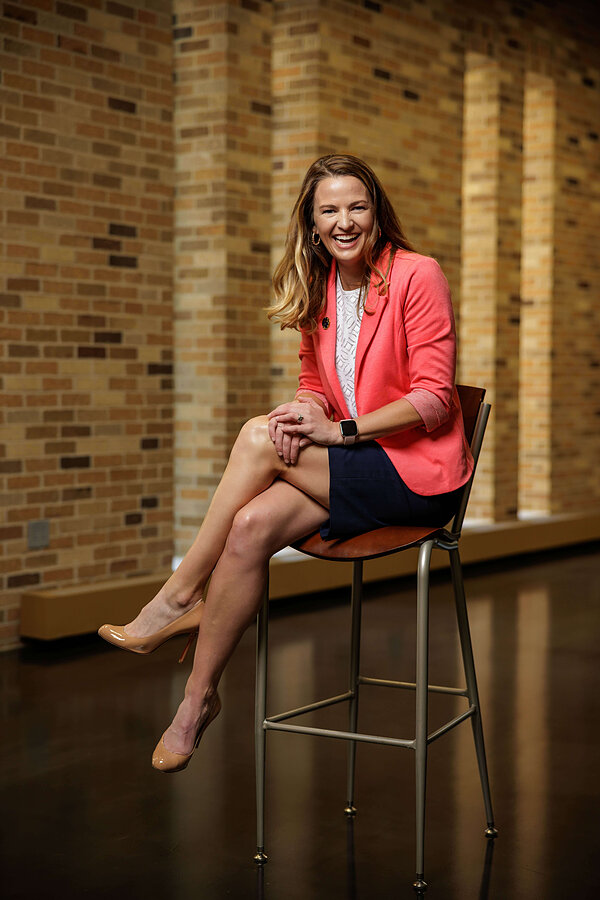
The American Chemical Society (ACS) has awarded Kate Biberdorf, professor for the public understanding of science at the University of Notre Dame, with the James T. Grady–James H. Stack Award for Interpreting Chemistry for the Public.
Known best as Kate the Chemist, Biberdorf holds a doctorate in chemistry and is well known for her work as a science entertainer and educator.
“This award validates a transition I've been making deliberately,” Biberdorf said. “I spent years as a science entertainer doing demonstrations with flames on a stage for a large crowd. Moving toward being a science communicator meant treating this as a discipline with its own methods and standards, not simply a performance.”
Biberdorf joined the faculty at Notre Dame in 2024 after working for a decade at the University of Texas at Austin, with her most recent role there as associate professor of instruction and director of demonstrations and outreach. Since arriving at Notre Dame, she has engaged students and faculty across the University, and is pioneering models that other institutions are beginning to emulate, said Steve Corcelli, the William K. Warren Foundation Dean of the College of Science.
“Her efforts increase chemistry’s visibility, elevate the quality of engagement, and set new standards for integrating communication into the academic mission,” Corcelli said.
As Kate the Chemist, Biberdorf reaches millions through books, stage shows, television, and digital platforms. She translates chemical principles into unforgettable experiences, turning demonstrations into entry points for genuine scientific understanding.
“The Grady-Stack Award seeks to honor those who interpret chemistry clearly to diverse publics, expand its reach, and stimulate curiosity. Dr. Biberdorf does this at a scale and with unmatched creativity in our field,” Corcelli said. “Her work inspires wonder, builds trust, and strengthens public understanding of science.”
Winning the award signals to Biberdorf that her colleagues in chemistry recognize her efforts in championing science communications in addition to being a science entertainer.
“This award tells me my colleagues in chemistry recognize that distinction and consider it worth honoring,” she said. “Mostly, it has made me want to do more of it. I'd like to build more collaborations across campus, and to expand the trainings I host for Notre Dame scientists who want to talk about their research in a way people actually understand.
“That is the part of this I'm most excited to pursue.”
Biberdorf will be honored at the ACS awards ceremony in March 2027 in conjunction with the Society’s spring meeting.
“My entire role here is to direct attention toward the remarkable science being done by my colleagues,” she said, listing specific researchers and their accomplishments. “Three of our faculty earned NSF CAREER Awards this year alone!”
That work deserves a national audience, she said, and her award suggests the wider chemistry world is beginning to look at Notre Dame as a leader in the field of chemistry.
“I hope it's the first of many awards for the department over the next few years, and I intend to keep making the case,” she said.