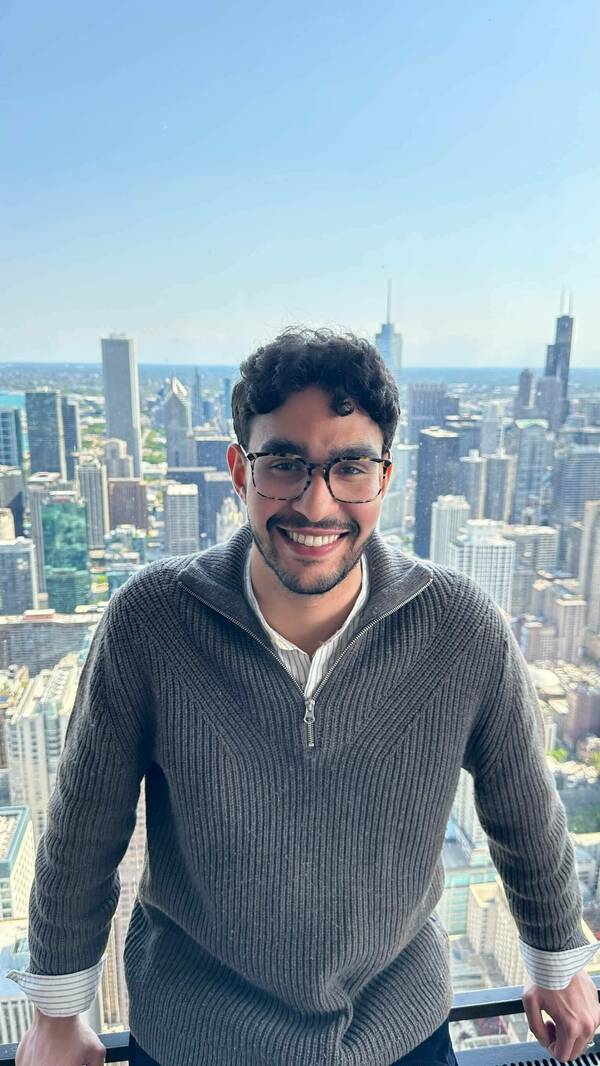
University of Notre Dame doctoral student Mohamed El Gazzah has been awarded a highly competitive national fellowship from the U.S. Department of Energy to conduct research on novel magnetic textures at Oak Ridge National Laboratory (ORNL), in Oak Ridge, Tennessee.
As an awardee of the DOE Office of Science Graduate Student Research (SCGSR) program, El Gazzah, who works in the lab of Associate Professor Nirmal Ghimire in the Department of Physics and Astronomy, will spend a year with a mentor at the national laboratory beginning in January 2026.
El Gazzah’s research focuses on advanced magnetic structures known as skyrmions. These tiny, swirling magnetic configurations have vast technological potential. Unlike traditional magnets, like iron, which are well understood, skyrmions are topologically complex textures. Researchers are in the stages of understanding how to create, control, and detect them efficiently.
However, skyrmions are already known to hold promise for improving data storage technologies, El Gazzah said.
“They are “distinct magnetic entities, which are unique to their background,” said El Gazzah, whose lab is affiliated with the Stavropoulos Center for Complex Quantum Matter. “And so, you can identify a single skyrmion, meaning that you can translate that into bits.”
Unlike current memory technologies that rely on ferromagnetic domains, which require large current densities —skyrmions offer a far more energy-efficient alternative, El Gazzah said.
Magnetic skyrmions were first discovered in 2009. Because of their potential application in spin based electronic devices and data storage, research in this field received worldwide attention, El Gazzah said.
“To better understand their properties, it is very important to be able to see them, and at the same time measure their electrical properties,” he said.
As a part of this fellowship, El Gazzah will work with a mentor at ORNL to develop and use a new technique where imaging and electrical measurements can be done simultaneously, through a Lorentz transmission electron microscope.
A similar microscope is located at the Notre Dame Integrated Imaging Facility, and after completing his project at ORNL, El Gazzah plans to leverage his gained experience in developing similar capabilities at the university.
In his research so far, El Gazzah has already made significant progress. He has discovered a way to design and create skyrmions in a specific set of materials deliberately, rather than discovering them by chance. In fact, he will continue work to create skyrmions in similar systems with the aim of reducing their size and stabilizing them without the requirement of external magnetic fields, which are critical steps toward eventually using them in electronic devices.
Receiving the fellowship was a joyful surprise, he said.
“I actually never anticipated getting this, but I remember when I first got the email notification… I jumped in the air,” he described. He said he is grateful to Ghimire, his peers, and lab mates, all of whom have been an important part of his physics journey.