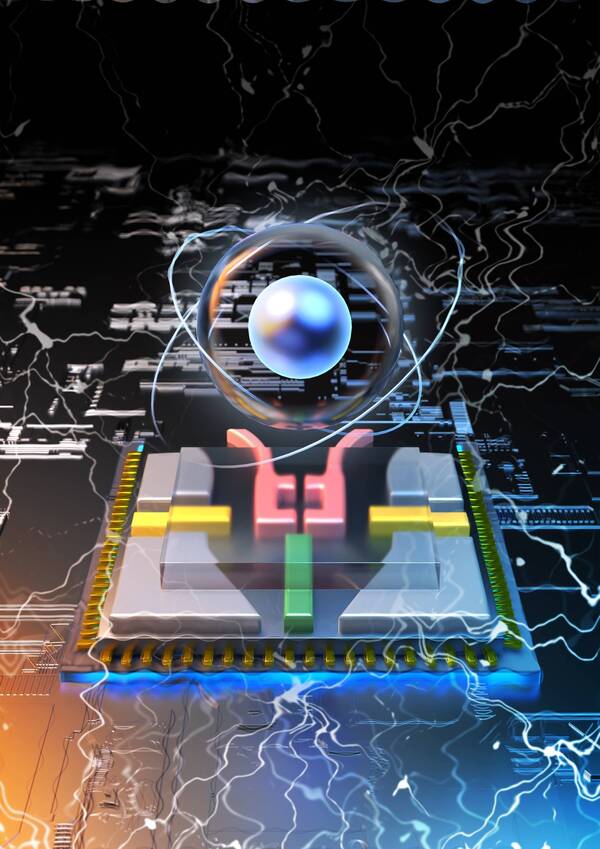
The world hasn’t yet embraced quantum computing because the technology hasn’t overcome a fundamental issue: Noise. It causes quantum bits (qubits), building blocks of a quantum computer, to lose their information.
In a recent study in Nature Electronics, a team led by Dafei Jin, an associate professor of physics in the Department of Physics and Astronomy at the University of Notre Dame, and collaborators have provided new insight into how well a qubit platform they invented in 2022 is resilient against noise. Their qubit, a trapped, single electron on the surface of frozen neon, is 10 to 10,000 times quieter than traditional qubits.
Traditional qubits are prone to disturbances from their material environments. Jin and his collaborators embarked on a novel approach using frozen neon, an ultraclean solid, to hold qubits. Jin’s team trapped a single electron above the neon surface using a superconducting circuit that can be operated without any dissipation. The spatial motion of the trapped electron represents the "0" and "1" states of quantum information.
“We managed to compare the solid-neon environment with other materials and show its superiority,” said Jin.
The work was completed at the University of Notre Dame and Argonne National Laboratory. During the research, Jin’s team studied frequencies outside of the so-called sweet spot, to investigate how the neon environment affected the qubit compared with other materials.
The "quietness" of the neon environment allows the qubits to maintain their quantum states for a much longer time. This enables more complex calculations with fewer errors, potentially clearing the way for large-scale, high-performance quantum computers that could solve problems that even the fastest classical computers cannot.
The neon qubit would also be less expensive to manufacture, since electrons are freely available from lightbulb filaments.
Jin and his collaborators have already begun follow-up research to remove imperfections from the neon surface and reduce remaining noise from stray electrons.
"By thoroughly characterizing the qubit's noise properties, this study shows why its performance is so good," said Xu Han, a scientist at Argonne co-author. "Our results prove that our technology is promising for quantum information processing at larger scales."
This collaborative effort included researchers from Argonne National Laboratory, University of Chicago, Harvard University, Northeastern University, and Florida State University. The research was supported by the U.S. Department of Energy, Air Force Office of Scientific Research, and the National Science Foundation.