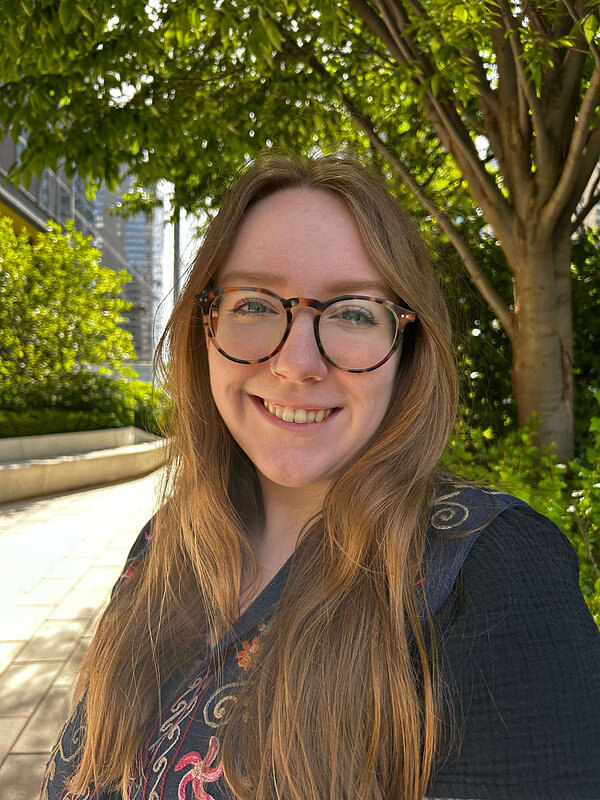
University of Notre Dame’s Lauren Henderson, a fifth-year doctoral student in the Department of Physics and Astronomy, has been awarded the prestigious Amelia Earhart Fellowship, presented by Zonta International.
Henderson has used the fellowship to support her research on ancient stars. Her doctoral work falls into the field of galactic archeology.
“It's like doing archeology in a way, where you dig up some ancient artifact and you piece together what an ancient civilization was doing,” she said. “Well, we're looking at these really ancient stars and piecing together how the Milky Way and its surrounding galaxies evolved over time.”
More specifically, Henderson works in the lab of Associate Professor of Physics and Astronomy Evan Kirby, and they study stars in dwarf spheroidal galaxies around the Milky Way. Dwarf spheroidal galaxies, as explained by Henderson, are “really small, unimpressive-looking galaxies” that are mostly clumps of stars and dark matter. She studies the stars inside of these galaxies because of their age, analyzing them through spectroscopy to understand how heavy elements were made inside of them.
“When I suggested this project to Lauren more than three years ago, I had a particular focus in mind: determine how long galaxies lived,” Kirby said. “Rather than fixating on the goal I had in mind, Lauren followed where the data took her. Instead of taking my word for what the data would say, she found a different conclusion on a related topic: the sources of the heaviest elements of the periodic table.”
The $10,000 Amelia Earhart Fellowship is awarded to up to 30 women pursuing doctoral degrees in aerospace engineering and space sciences, a place where they are historically underrepresented.
Henderson said she feels being awarded a fellowship focused on women in space science aligns closely with her core values.
“Growing up I knew I always wanted to be a scientist, and unfortunately, it's still the case that in media, you either see male scientists or a very specific way that female scientists are portrayed, and a lot of little girls can't see themselves being a scientist because of that,” Henderson said. “Increasing representation of women and other underrepresented minorities in physics and astronomy has always been really important to me because it's just so clearly a problem.”
The fellowship will allow Henderson to continue her research, travel to conferences and connect with other women in science.
As her doctoral program reaches its final stretch, she plans to continue her research in galactic archeology, hoping to apply to post doctorate positions in the fall of 2027 and graduate the following spring. Eventually, Henderson wants to move to a faculty position where she can teach and have her own research group.