
When University of Notre Dame biology major Sebastian Benedetto ’26 was a junior in high school, he faced a new reality: He might have to go through life with a walker or a cane, never able to walk unaided again.
The elite teenage bagpiper from Maine was also a cross-country runner and accomplished student when he began noticing unusual medical symptoms in 2019. He experienced rashes, and then occasional numbness, and fairly quickly lost mobility in his right leg and arm.
Months spent in hospitals and at doctor appointments yielded no answers. Maybe spinal cancer? Maybe an infectious disease? Physicians were baffled, and no diagnosis seemed to fit.
After a stay at Boston Children’s hospital in December 2019, he was discharged with a wheelchair. The prognosis: Benedetto’s partial paralysis was likely permanent, even though physicians didn’t know what was wrong.
“Basically, you know, the way I took it was like, 'This is your life now, happy holidays,'” Benedetto said. “And wow, that sucks.”
Yet today, not only is he fully mobile, but he serves as the pipe major of the University of Notre Dame Bagpipe Band—a role that’s similar to a conductor and lead instructor combined. He is applying for doctoral programs in ecology. Disciplined and determined, he rebuilt his life after missing a year of high school and wondering if he would have to readjust some of his life’s goals.

The Medical Mystery
Benedetto’s dermatological symptoms began the summer before his junior year, and led to his partial paralysis by September.
“At one point (doctors) thought I had an infectious disease, so I was quarantined for a week and a half,” he said. “People were wearing hazmat suits around me and everything.”

Though he needed to use a cane or a walker when he was not in a wheelchair, he did not want to abandon his music. While still partially immobile, Benedetto, already a top-ranked youth bagpiper after just six years of study, entered a competition called the Balmoral Classic in November 2019. The Classic is a prestigious invitational competition for top-tier bagpipers under 21, loosely described as the youth North American championships. He couldn't march, and he couldn't stand. But as a fierce competitor who loved playing, he figured he could still compete.
Judges provided a stool to accommodate his disability. Because he had mastered the Great Highland bagpipes incredibly quickly, Benedetto relied on muscle memory in his right hand to play the chanter portion of the bagpipes—the recorder-like part of the instrument that creates the melody. Thankfully, pipers only use the fingers of their right hands to play the bottom four holes of the instrument, while the left hand plays the upper portion. The bagpipe’s “fuel” comes from the housecat-sized bag they squeeze, using their upper left arms.
After competing in different aspects of the competition, Benedetto placed third overall.
“I rallied because I wanted to do this, and I really loved competing,” he said.
A doctor’s memory to the rescue
As he began resigning himself to a different type of life experience than he had imagined, an orthopedic surgeon at Boston Children’s Hospital recalled an obscure case she had read about in an Italian medical journal.
She had a hunch that Benedetto didn’t have a disease, and he didn’t have cancer. And she was right: He had a rare congenital lesion on his spine called an intrasacral meningoceles. The lesion is a cyst caused when the spinal sheath—the protective membrane around the spinal cord—slips out of the vertebra and fills with spinal fluid. In Benedetto's case, it was pressing against the nerves in his sacrum, the large bone at the base of the lumbar spine. Because the cyst was filled with clear spinal fluid, it had been invisible on standard scans.
His case was only the 13th to be diagnosed in an older child, he said.
Once identified, there wasn’t too much time to celebrate, however, because removing the cyst required a demanding, nine-hour surgery on January 6, 2020.
But the relief? It came just four days after the surgery.

“Very feebly I was able to just start walking,” he said, describing how he took his first steps after the medical staff removed all IVs and other medical supports. “It was crazy. I was like, ‘whoa.’”
Of course, he had lost muscle tone in his legs and arm that he had to rebuild, and he spent the subsequent months of the COVID-19 lockdown rebuilding his body, completing classwork, and piping. While the rest of the world shut down in 2020, he finished three classes, competed in online bagpiping competitions, and placed second in the Balmoral Classic that year. The ordeal did cause him to graduate one year late, however.
“Everyone's like, 'Oh my God, 2020, this is awful,’” he said about the response by most about the COVID-era closures. “I'm like, 'Hey, I can walk! This is awesome!'”
A life in music
Benedetto’s resilience is rooted in discipline. Though the Great Highland bagpipes were developed in Scotland by shepherds and made famous as an instrument to intimidate enemies during wars, he doesn’t have roots in Scotland. His mother is Scots-Irish via Newfoundland, and his father is Italian—but the instrument called to him early.
“I was probably four or five, and my mom took me to the Highland Games in Vermont,” he said. After hearing the pipes, he was hooked immediately. “I was like, 'Oh, Mom, what's that? I want to play that . . . no. I'm gonna play that.”
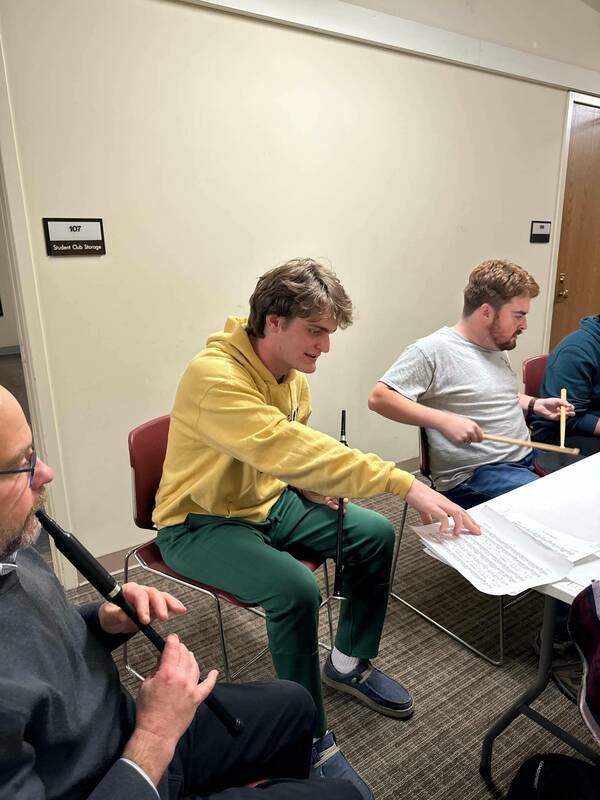
But he didn’t begin lessons until a few years later, at age 11, with world-class instructor Lezlie Webster, the first female piping judge in the United States. During his first lesson, Benedetto was already playing tunes on the practice chanter—the stand-alone recorder-like device all pipers learn to play first because it’s not connected to a bag or drones, allowing students to master melodies. He graduated to the full bagpipes in just a few months, a process that can take many beginners a year or longer.
By the time he arrived at Notre Dame, Benedetto was an accomplished bagpiper playing at the highest amateur level, Grade 1. He joined the University's bagpipe band, taking over as pipe major during his sophomore year. Under his leadership, the band has transformed from a small club into a larger group with more than 25 bagpipers, five drummers, and competitive aspirations.
"Seb is one of the finest pipers you could ever hear,” said Dominic Vachon, one of the faculty advisors for the band and the John G. Sheedy M.D. Director of the Ruth M. Hillebrand Center for Compassionate Care in Medicine in the College of Science. “But besides being one of the finest pipers we have ever had here at Notre Dame, he is generous with his talent.
“No matter what level of piper a person is in the band—beginner, intermediate, or advanced—Seb takes the time to make that person even better. As a result, the whole band sounds amazing!"
Part of the reason for the amazing sound is because Benedetto, who is 6’1’” with a booming voice, is a demanding leader who expects his bandmates to share his dedication.
“I am very picky,” he said. “If you choose not to change or improve, which is totally fine, you're just going to have to also acknowledge that I'm still going to be telling you to change, because the goal of many people in this band is to improve,” he said.
He has worked to balance the University’s Gameday requirements with musicality. The Notre Dame Bagpipe Band’s numbers had dwindled after 1954, when it was pulled from marching onto the field after it became clear that bagpipes and freezing November games do not mix. The band, although small, began to play regularly in the early 2000s, but didn’t regain popularity until former Notre Dame football coach Brian Kelly requested in 2011 that the bagpipe band lead the well-known Player Walk two hours before kickoff.
During the past few years, Benedetto and the lead drummer, civil engineering major Evan Johnston ’26, have continued introducing complex medleys and new scores to challenge the musicians.

Benedetto’s vision for the program extends beyond his graduation. He hopes to see the University eventually hire a professional instructor to ensure continuity, similar to programs at Carnegie Mellon University in Pittsburgh or Simon Fraser University in British Columbia, Canada, which boast award-winning pipe bands.
Though that would entail further financial backing, a professional instructor who could continuously lead the band through the four-year cycles of bagpipers “is what's really going to take us further,” Benedetto said.
The scientist and bird lover
While he loves the notes of piping, Benedetto also loves another type of note melody: birdsong. He’s fascinated by ornithology, ecology, and evolution, and time spent abroad in South Africa fueled his interest in biodiversity hotspots. These are parts of the world with a rich mix of plant and animal species but also a high potential for habitat destruction.
“I had always been interested in zoology, and went through various phases of mammals, then reptiles, then fish, then insects for a solid two years, before landing on birds when I was 8,” Benedetto said.

He was drawn to the vast diversity of species and the variety of adaptations by the various species. Birding—the act of trekking outside to seek out and identify birds—added an extra tangible hobby to his passion. His deep dive into birding afforded him the opportunity to see a couple of species in Maine that generally do not pass through the area, including a surfbird and a gyrfalcon.
In South Africa, he searched for a new subset of species in a variety of biomes, which are distinct geographical regions characterized by unique climates. He tracked a breeding pair of rare Cape Eagle owls along the coast of Cape Fynbos, and explored the savannah of Kruger National Park for secretarybirds and Southern ground-hornbills, among other bird-seeking adventures.
“The diversity and sheer quantity of species was a wonder to behold,” he said. “It is something really unique when nature is more common than the anthropogenic environments that change them, and this opportunity to intimately connect with such wild ecosystems was truly an honor and a blessing.”
Because of his interest in ornithology, Benedetto designed the bird displays for the University’s Museum of Biodiversity in Jordan Hall of Science. He said he “had to fight my inner scientist that wanted to display all this cool information (about the birds) in a less accessible way.” He realized that the goal was to allow visitors to draw connections between species across geographic distributions to emphasize the variety, but also the similarities, in different ecological communities.
“The final display is structured to emphasize the vertical structure of the different layers of tropical rainforests,” he said.
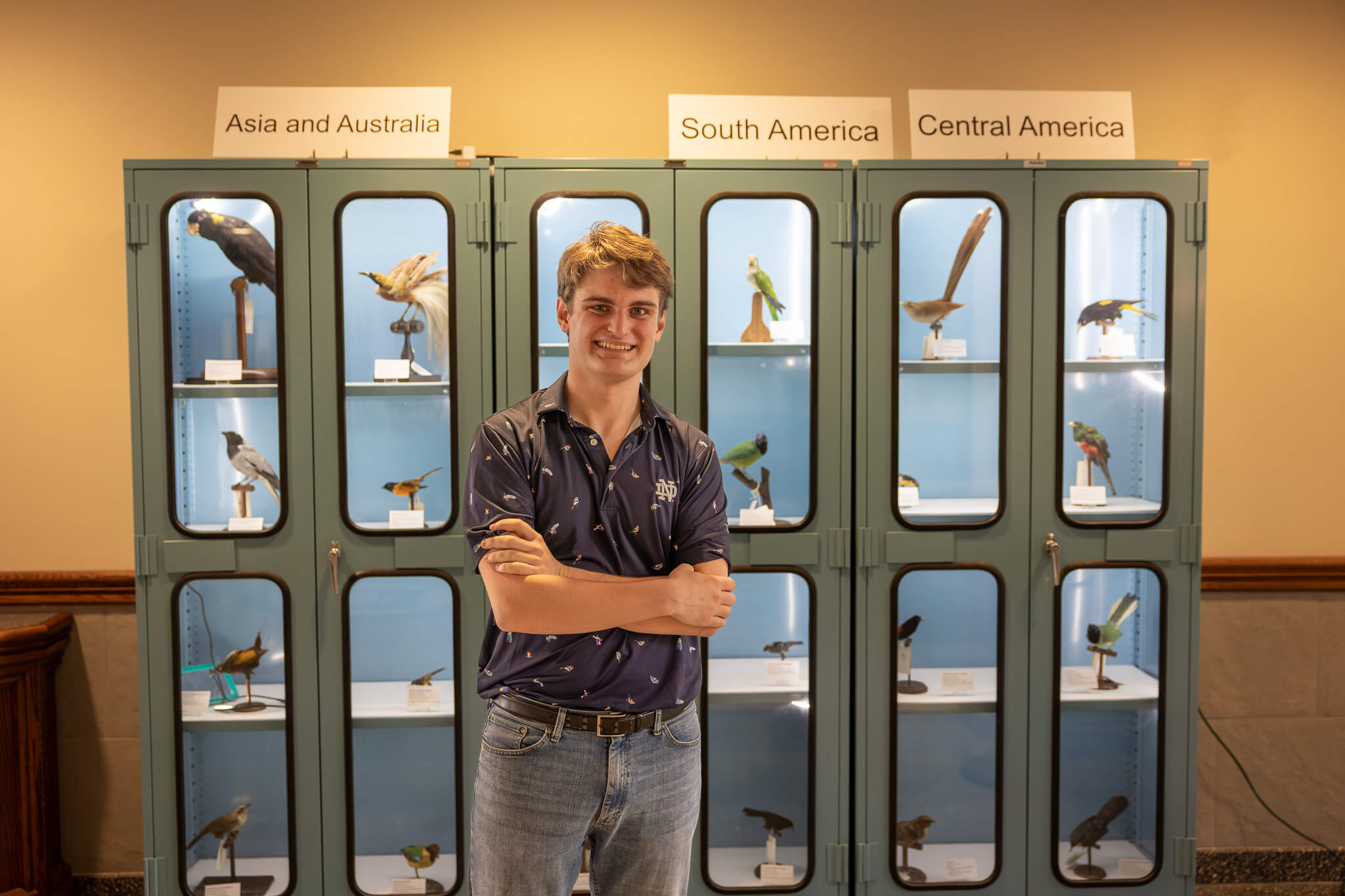
His passion for birds is infectious, said Joanna Larson, curator of the Museum of Biodiversity and the Greene-Nieuwland Herbarium, as well as an assistant professor of the practice in the Department of Biological Sciences.
“His ornithological knowledge is so impressive for someone his age,” she said.
As Benedetto applies to doctoral programs, his focus is on institutions with labs that do research in ecology and evolutionary biology.
And yes, he’s also considering whether those universities have bagpipe bands.
“I’m looking at seeing whether I can at least do monthly practices,” he joked.
That shouldn’t be an obstacle, considering Benedetto was once a partially paralyzed teenager who had to rebuild his ability to walk.
“I've always had enough conviction that I can make something work out with whatever is given to me,” he said.
