
The lights beaming down on Generoso “Jerry” Rullo ’26 felt shockingly bright at Notre Dame Stadium at the end of the Florida State game in 2024. Even though Notre Dame was ahead by more than 40 points, Rullo, a walk-on linebacker taking his position on the iconic football field for the first time, felt a twinge of fear as he faced off against a lineman.
“He looked really big in person, more than you’d think,” said Rullo. The surreal scene briefly reminded him of controlling a player in an EA Sports’ Madden NFL video game.
“I kind of instinctively tuned it out,” he said, thinking back to his training. “Once your instincts kick in, you know, you go where you need to go.”
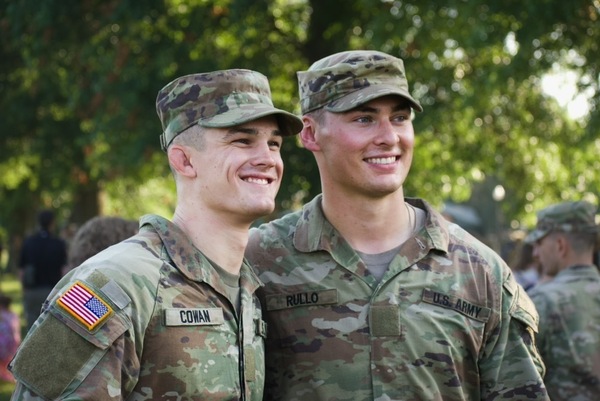
Rullo’s parents met at Notre Dame as part of the U.S. Army ROTC program, which he also joined when he arrived on campus in 2022. The neuroscience and behavior major from Havertown, Pennsylvania, played football and lacrosse in high school, and considered himself an athlete, enjoying contributing to his teams and competing. At the time, however, playing football at Notre Dame wasn’t something he believed could be possible.
“When it came to going to college, you know, I always had more of an academic focus, and the place I wanted to go to college, first and foremost for me, was Notre Dame,” said Rullo, who has long planned on becoming a physician.
It’s a goal he’s one step closer to achieving. The walk-on football player recently accepted an offer to study medicine at Harvard Medical School, a level of achievement accomplished by only about 200 students from around the world each year, with an average of just two each year from Notre Dame.
“He is a wonderful human being, and his ability to manage and prioritize tasks is truly exceptional,” said Kathleen Kolberg, associate dean in the College of Science and assistant director of the Center for Health Sciences Advising.
Family Ties to ROTC and Boxing
Rullo’s deep commitment to serve his country was influenced by his parents, but he also sees the program as a means to gain a lifelong, strong character. His uncle, George Keough, was also an Army ROTC cadet at Notre Dame and later became an Army physician.
“Talking with him definitely helped solidify my decision to become an Army physician because he has a strong impression of his time in service and the value of delivering care in that role,” Rullo said, adding that his uncle is now a dermatologist in private practice. “He always has positive and encouraging messages about the profession and is a great example for both callings, medicine and military.”
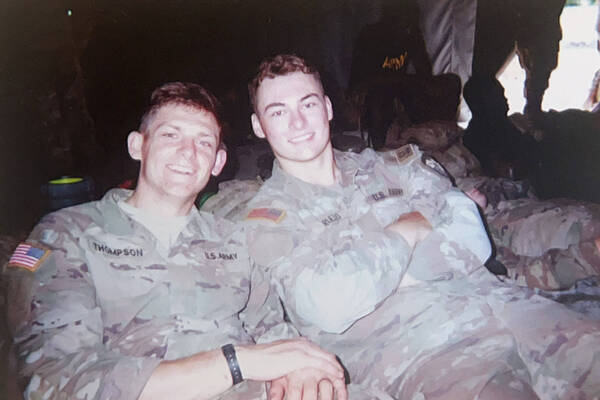
One of Rullo’s ROTC friends, Lucas Brenninkmeyer, is a senior majoring in environmental engineering, and said that Rullo stands out in part because he balances so many roles well.
“He works an all-night job on Sunday nights (assisting a student on campus) and still will come to PT at 0600 on Monday just like everyone else,” Brenninkmeyer said.
While regular physical fitness in ROTC itself is rigorous, Rullo took on an additional challenge by working out with the Brigade Ranger Challenge team in 2023, an Army ROTC varsity sport that culminates in a two-day competition.
“They do the hardest workouts I’ve ever done,” said Rullo, a 2025 finalist for the Navy Federal Credit Union ROTC All-American Scholarship. “I mean, it’s like they’ve kind of perfected the formula for how to get you on the verge of wanting to throw up and keel over.”
At least a part of Rullo’s athletic drive might be rooted in a deep family legacy. Jerry’s grandfather, Generoso Charles “Jerry” Rullo Jr., played four seasons with the Basketball Association of America and later, after a merger, the National Basketball Association, for the Philadelphia Warriors. Rullo and the Warriors won the first NBA championship series in 1947.
"My grandparents were Italian immigrants," said Rullo’s father, Generoso “Jerry” Rullo III, describing how his basketball-playing father, and likely, his football-playing son, share a common internal drive. "Just, you know, work hard and I think stay humble, right? I think that takes care of a lot of the problems that you face in life."
Attracted to Notre Dame’s Bengal Bouts boxing club’s mission of charity, camaraderie and competition, Rullo decided to join the group to learn how to box his freshman year, on the heels of completing an optional two-week ROTC training regimen. But those are not the only reasons: There’s also some family history. His great uncle was a U.S. Army boxer. Affectionately known to Rullo as “Great Uncle Bomber,” he was a World War II veteran and Prisoner of War (POW) in Germany.
“My dad and Pop Pop looked up to him,” Rullo said. “That was a strong motivation for me, and a really cool aspect of family history.”
Because Bengal Bouts also attracts graduate students, advancing through the rounds as a freshman is tough, and Rullo wasn’t sure he had what it took to win. But his rigorous ROTC training came through for him, and he clinched the heavyweight division in 2023 during his first year at Notre Dame.
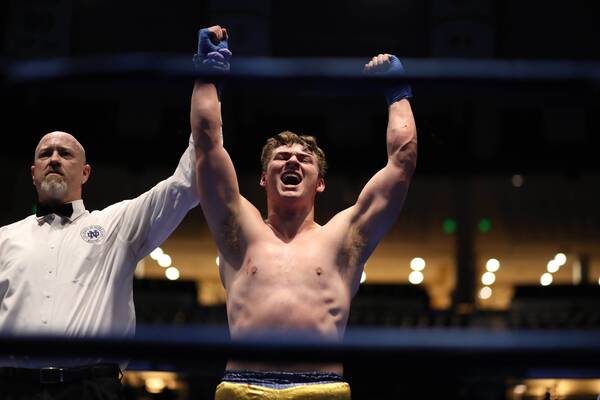
“He is very internally driven,” his mother, Peggy Rullo, said. “If he decides he’s going to do something, there's nothing on the outside that’s going to discourage him from taking that chance, no matter how remote the possibility of success is.”
Notre Dame Football team tryouts
Rullo knew he wanted to focus on academics and ROTC while at Notre Dame, and yet, the challenge of trying out for a non-scholarship spot on the football team was enticing. Since he keeps some aspirations close to the vest, his parents didn’t even know he was interested until he took the chance.
Rullo did ask LTC William Kobbe, professor of military science at Notre Dame, for permission to try out for the team. Kobbe joked that he himself is “a washed-up former JV player in school who once considered trying out to be a walk-on at Villanova University but didn’t do it, and always regretted it.” So he encouraged Rullo to go for it. If Rullo made it, Kobbe told him, it would only further develop his leadership skills.
Though he hadn’t submitted films and didn’t make moves to be recruited in any program, Rullo did keep in touch with a professional football player from his high school, William Penn Charter School in Philadelphia, to find out how he could try out as a walk-on at Notre Dame. From his high school contact, Rullo discovered that he had to fill out a simple form, and that the tryouts for the Notre Dame football team would begin just three days after his boxing win.
He submitted some details about himself, plus some film from high school, on the form. He showed up to the tryout, sporting a shiner from his boxing match and feeling the effects of dry socket, a painful gum complication that developed after his wisdom teeth were extracted. Energized but tired, Rullo felt the pressure to land a coveted spot when he showed up for the tryout.
“It was less scary than the boxing ring,” he joked.
Thankfully, it took only a few days to receive the good news. He was going to be #46 for the Fighting Irish.

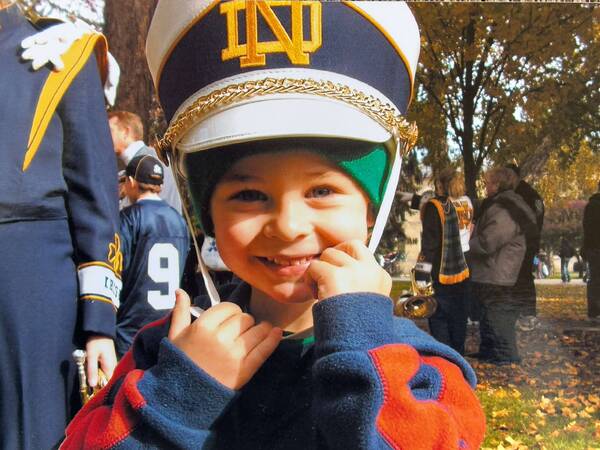
“It felt surreal,” he said, adding that he also felt a little overwhelmed. His father was speechless, and just as excited as his son.
The new change to his life involved having to reschedule a section of one of his science classes to a later class, so that he could attend the morning football practices. On the first day of practice, Rullo didn’t even know if he had access to get into the practice facility. Thankfully, one of his dorm mates was offensive lineman and then-backup right tackle Aamil Wagner, who offered to let Rullo follow him into the building.
“I then just kind of hung around in the locker room, waiting for someone to tell me what to do, but the next thing you know, I was meeting Coach (Marcus) Freeman, and I was in front of the whole team auditorium introducing myself,” he said.
In addition to playing against Florida State during his junior year, Rullo was out on the field for three drives against Army at Yankee Stadium, a game naturally special to him because of ROTC. He made a shoestring tackle—a tackle made around the ankles—of a Syracuse quarterback during the 2025 game that Notre Dame won.
“I think his name was announced on the tackle,” Rullo’s father said. “The other parents around us were turning around, giving us high fives, on, you know, a tackle that didn’t mean anything to pretty much anybody else watching the game except for his friends (because Notre Dame was so far ahead), but his teammates were all excited.
“It was just wholesome and fun, and unexpected,” his father continued. “Pure joy.”
Rullo echoed the excitement, but stressed that that feeling of camaraderie didn’t occur just during wins. It permeated the feeling of the entire program. While some organizations may excel based on an expectation of cutthroat competition, Rullo didn’t find that at Notre Dame.
“The pleasant surprise was that every person was so welcoming, more than you’d expect from an organization like that sometimes,” he said. “I was kind of taken aback just by how kind all of my teammates were.
“This says a lot about Notre Dame specifically, because it’s probably not something that you’re going to find many places. So many guys just go out of their way to be kind people, even off the football field.”

Drive for medical school
Though Rullo was on the field for Notre Dame drives during football season, his driving force in life has been toward medicine, a calling he felt even in high school. He has a natural affinity for science and math, and even earned a 524—nearly a perfect score—on his Medical College Admission Test (MCAT).
Since middle school, Rullo has considered medicine as the most meaningful application of his scientific knowledge. He was in middle school when his basketball-star grandfather Jerry was diagnosed with Alzheimer's disease. His grandfather’s death in 2016 marked the first time Rullo seriously considered pursuing neuroscience or medicine as a purposeful way to prevent a disease that he saw as destructive to many facets of human life.
His grandmother Eileen, with whom he was close, then developed dementia herself while Rullo was in high school. She used to love going to Rullo’s sporting events as well as those of his younger siblings—two brothers and a sister, he said. Before her death in 2024, Eileen Rullo experienced more acute issues stemming from her dementia, and needed extra help.
“Helping her when she needed it sometimes took up time that I'd normally have spent on other things, but once again it was important to me and something that I am glad I could have had a hand in,” he said. “Once I left for college, the first thing I'd often do anytime I'd come home was to visit her.”
Rullo’s passion for the medical field only blossomed more when he started at Notre Dame and decided to major in neuroscience and behavior. The coursework provides a unique lens for his interests. Rullo views it as “a cool blend of biology and psychology.”
“I sort of like taking things from the cellular level and the foundations of biology and working up all the way until reaching the order of human cognition, behavior,” he said, adding that he loves the discipline because the brain is one of the most complex systems in the universe.

“Our experience here on Earth runs through our brain. So you know, what better thing to study and to try to understand then, right?” he said, adding that he did understand the irony of studying the brain while boxing and playing football, two sports that can cause debilitating head injuries.
That’s not saying he’ll necessarily focus on neurology in medical school, because he’s keeping an open mind. Right now he’s drawn toward surgery or emergency medicine. Rullo is structuring his medical school journey through an education delay, where his service to the military will be postponed until possibly after residency. He will then serve as a physician for the U.S. Army.
Partly because of his volunteer work in hospice care and his travels to Tanzania and Kenya as part of Project Global Officer through ROTC, where he gained proficiency in Swahili, he doesn’t see work in medicine as simply a calling or a profession.
It’s his way to serve.
“You’re working in the most meaningful way; I think one of the most meaningful applications of human knowledge and practice is to work with a patient who is, say, on the precipice of life and death,” he said. “I think it has so much inherent meaning to be a human force with that patient, to kind of stand beside that patient.”
His work in hospice, in particular, showed him how to be present with people during their time of greatest need.
“I think the most rewarding thing has always been just stepping outside of your comfort zone and just being in that space and then that environment, and, you know, just kind of getting over yourself a little bit.”
Rullo was accepted into several medical schools, but knew after his interview at Harvard that it was the program for him. And while his mother Peggy and others point to his ability to tune out distractions and work efficiently—his ability to manage his time while taking on multiple activities started during childhood—others point to how well he’s willing to work for the good of the group.
“It’s always about working together for him,” his father said. “He would say to give it your all, because it’s not about him. It’s about ‘us.’”
Kobbe described Rullo as someone who not only has a natural aptitude for so many different endeavors, but is also respectful with the highest level of humility.
“He embodies the spirit of God, Country, Notre Dame,” Kobbe said. “He’s the ultimate, humble teammate.”
Story by Deanna Csomo Ferrell | Communications Associate Director, College of Science